What to Wear on a Flight When You Take Off in Summer and Land in Fall

Quick Answer: Dress for the colder destination, not the warmer departure, and make the warmth removable. Build the outfit from a base that works alone in 75F, then add exactly two removable pieces that take it to 55F. The mistake is dressing for departure and packing the warm layer in a bag you will not want to open in the aisle, or at baggage claim in the cold.
You leave in 85F and land somewhere it is 54F and raining. Between those two facts is a four-hour flight where the cabin is its own third climate.
One outfit has to work for all three, and the sequencing is what makes it work.
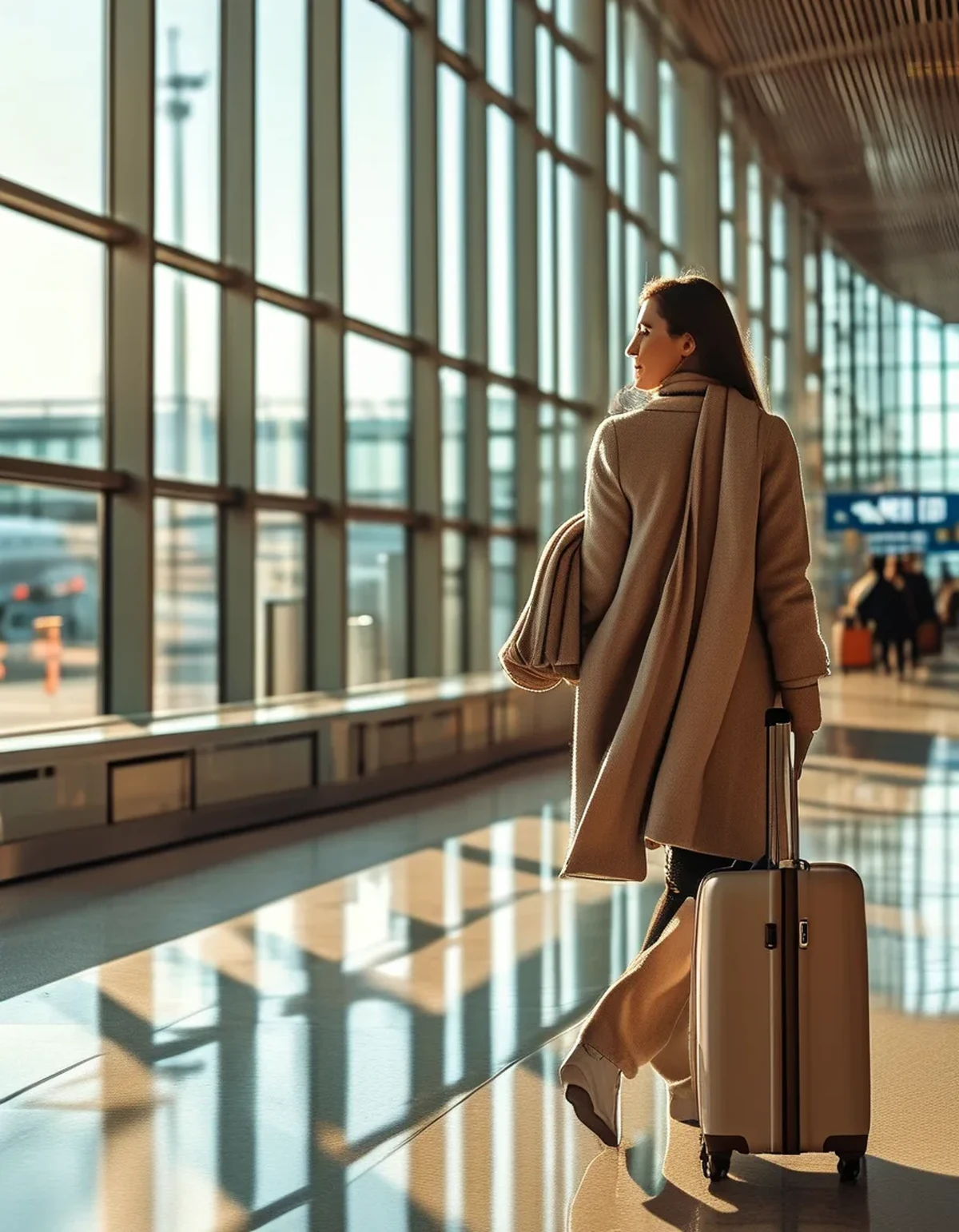
Why does dressing for departure always go wrong?
Because departure is the shortest and least uncomfortable part of the journey.
You spend maybe 45 minutes in the departure climate, most of it indoors in air conditioning. You spend three to six hours in a cabin held between 71 and 75F, which is cooler than most people expect and often feels cooler still because of the constant airflow. Then you spend the entire rest of your day in the arrival climate.
Dressing for the first 45 minutes optimizes for the smallest slice of the trip, and it puts your warm layer in a bag. Once boarding is done, retrieving something from an overhead bin means standing up in a narrow aisle and opening a case over other people’s heads - which is why most people simply endure being cold instead.
Dress for the destination and carry the removable warmth on your body or in the seat pocket. The 45 uncomfortable minutes at departure are a much better trade.
What does the two-layer rule actually look like?
A base that is genuinely comfortable alone at 75F, plus exactly two additions that carry it to about 55F.
The base: a fitted long-sleeve top and mid-weight bottoms. Long sleeves rather than short, because cabin airflow lands on forearms and shoulders, and because it is one less thing to add later. Mid-weight bottoms because legs cannot layer - this is the single decision that does the most work.
Addition one - a mid layer. A light knit or a fleece quarter-zip. This is your cabin layer, on and off repeatedly, so it should compress into the seat pocket without a fight.
Addition two - a shell. Wind and water resistant, packable. This is your arrival layer, and it turns a 60F outfit into a 50F outfit almost entirely by blocking wind.
Two pieces, not four. Every additional layer is something to carry, lose, or juggle at security, and three thin layers you keep are worth more than five you abandon at the gate.
What about shoes and the security line?
Shoes carry more weight in this decision than people account for, because they are the one thing you cannot adjust en route.
Closed shoes, always, for a cold arrival. Sandals that were correct at departure are a genuine problem in 54F rain, and there is no version of this where you change shoes at baggage claim.
Slip-on or fast-lace. Even where shoes stay on at security, gate-side changes and cabin comfort both favor something you can remove without sitting on the floor.
Socks in your personal item. Cabin floors are cold and feet swell in flight. A fresh pair before landing is disproportionately effective for how little space it takes.
And a note on the swelling: feet genuinely expand over a long flight due to fluid pooling. Shoes that fit perfectly at departure can be uncomfortable on descent, so a small amount of room is not sloppiness - it is planning.
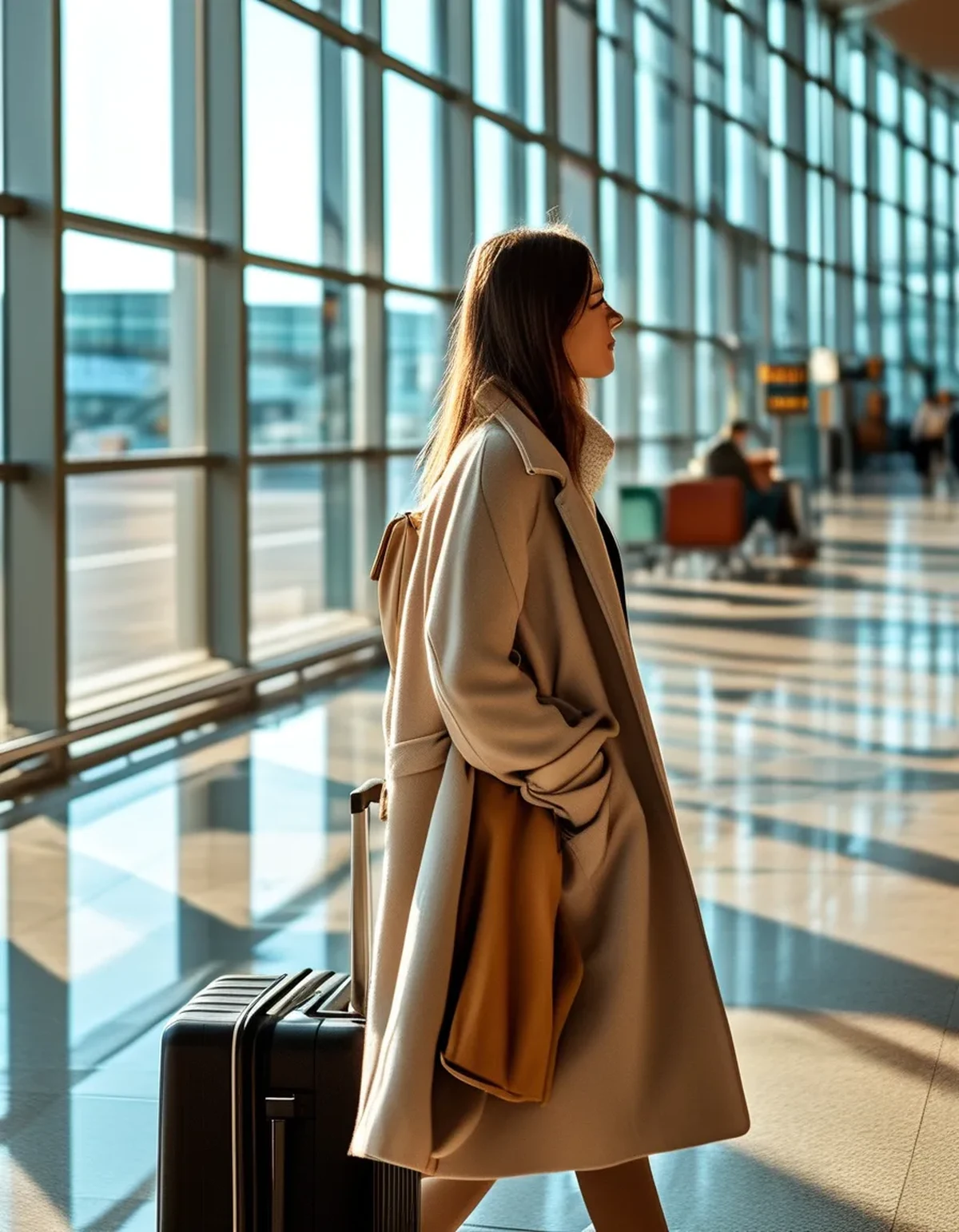
What Nobody Tells You About Cross-Season Travel Days
The cabin is colder than the announced temperature feels. Airlines typically hold cabins around 71-75F, but constant airflow makes it feel several degrees cooler, particularly on your arms and neck. People consistently underdress for this.
A scarf is the highest-value item in your bag. It is a neck warmer, a pillow, a blanket across the shoulders, and an eye cover. Nothing else in a carry-on does four jobs.
Your arrival layer should be accessible without opening the overhead bin. Put the shell in your personal item under the seat. Descent is exactly when you want it and exactly when you cannot stand up.
Dark bottoms are not vanity. Travel days involve spilled coffee, airport floors, and unidentifiable seat surfaces. This is the one context where practicality genuinely outranks preference.
Denim is the worst choice for the second climate. It is heavy, it does not insulate when damp, and it takes hours to dry. If your arrival forecast says rain, that is the single garment to leave at home.
How do you handle the first hour after landing?
The hour between landing and getting somewhere indoors is when the outfit is genuinely tested, and it is the part nobody plans.
Add both layers before you leave the aircraft, not at the jet bridge. Jet bridges are frequently the coldest point of the entire journey, and there is nowhere to stand and rearrange yourself once you are moving with a crowd.
Have your shell zipped and your scarf on before you stand up. If you are collecting checked luggage, expect 20-40 minutes in a hall that is often barely heated, followed by an outdoor transfer.
The test of a good travel outfit is not how it looks in the terminal. It is whether you are comfortable standing at a curb in the wind at 11pm, and whether getting to that state required opening a suitcase.
FAQ: Cross-Season Flight Outfit Questions, Answered
Should I wear my bulkiest item to save luggage space?
Within reason. Wearing a heavy coat saves real space, but a coat you must carry through four hours of terminal and cabin becomes a burden fast. The better version is wearing your bulkiest wearable layer and packing the true winter coat if the destination genuinely needs one.
Are leggings still the best flight bottom?
They are hard to beat for comfort and layer well under a shell, but mid-weight matters more than the category. Summer-weight leggings in a 54F arrival will be cold whatever the style. If the destination is genuinely cold, lined or heavier bottoms beat any thin pair.
What if my layover airport is a third climate?
Ignore it unless you are leaving the terminal. Layover terminals are climate-controlled and typically fall between your two extremes. Optimizing for a two-hour indoor stop tends to compromise the outfit for the part that actually matters.
TL;DR:
- Dress for the destination, not the departure. The cold end of the trip lasts far longer than the warm end.
- Build from a base that works alone at 75F, plus exactly two removable layers that take it to 55F.
- Mid-weight bottoms do the most work, because legs cannot layer.
- Keep the arrival shell in your personal item, not the overhead bin - descent is when you need it.
- Closed, slip-on shoes with a little room. Feet swell in flight.
- Skip denim if rain is forecast. It is heavy, cold when wet, and slow to dry.
A cross-season travel day is really a sequencing problem: the right pieces in the right order, with the warm ones reachable without standing up. Get that right and the same outfit carries you from an 85F curb to a 54F one without a single bag being opened.
See It in Motion
Seen here: Super High Waist Embossed Yoga Leggings with Inner Pocket — shop it on bubblelime.com
Keep Reading
This article is for general informational and styling purposes only. Fit, sizing, and product availability may vary.