Dressing for a September Red-Eye Without Arriving Wrecked

Quick Answer: Build a red-eye outfit in three temperature layers — a soft base you could sleep in, a mid layer you take off at cruising altitude, and one big outer piece that doubles as a blanket. Wear the heaviest items on your body, not in your bag, and choose one pair of shoes you can slip off and back on with swollen feet. Nothing with a rigid waistband.
There’s a specific kind of tired that only happens on a red-eye: you didn’t really sleep, you’re cold in a way that’s gotten into your bones, and your jeans have been cutting into you for five hours.
Almost none of that is the flight’s fault. It’s the outfit, and September makes it worse, because the airport you leave and the airport you land in are often two different seasons.
Why do red-eye flights feel colder than daytime ones?
Cabin temperature is usually held somewhere around 72°F, which sounds fine and is not. Your core temperature drops naturally overnight — that dip is part of how sleep works — so the same air that felt neutral at 2pm feels genuinely cold at 3am.
Add two things flying does to you. Cabin humidity sits near 10 to 20 percent, drier than most deserts, and dry air pulls heat off skin faster. And you’re sitting still, which means your own heat production is at its floor.
So the outfit has to solve a problem that changes across the flight. You’ll be warm boarding, fine for an hour, and cold from roughly the second hour until landing. Dress for the coldest part and take things off at the start, not the other way around.
What are the three layers, specifically?
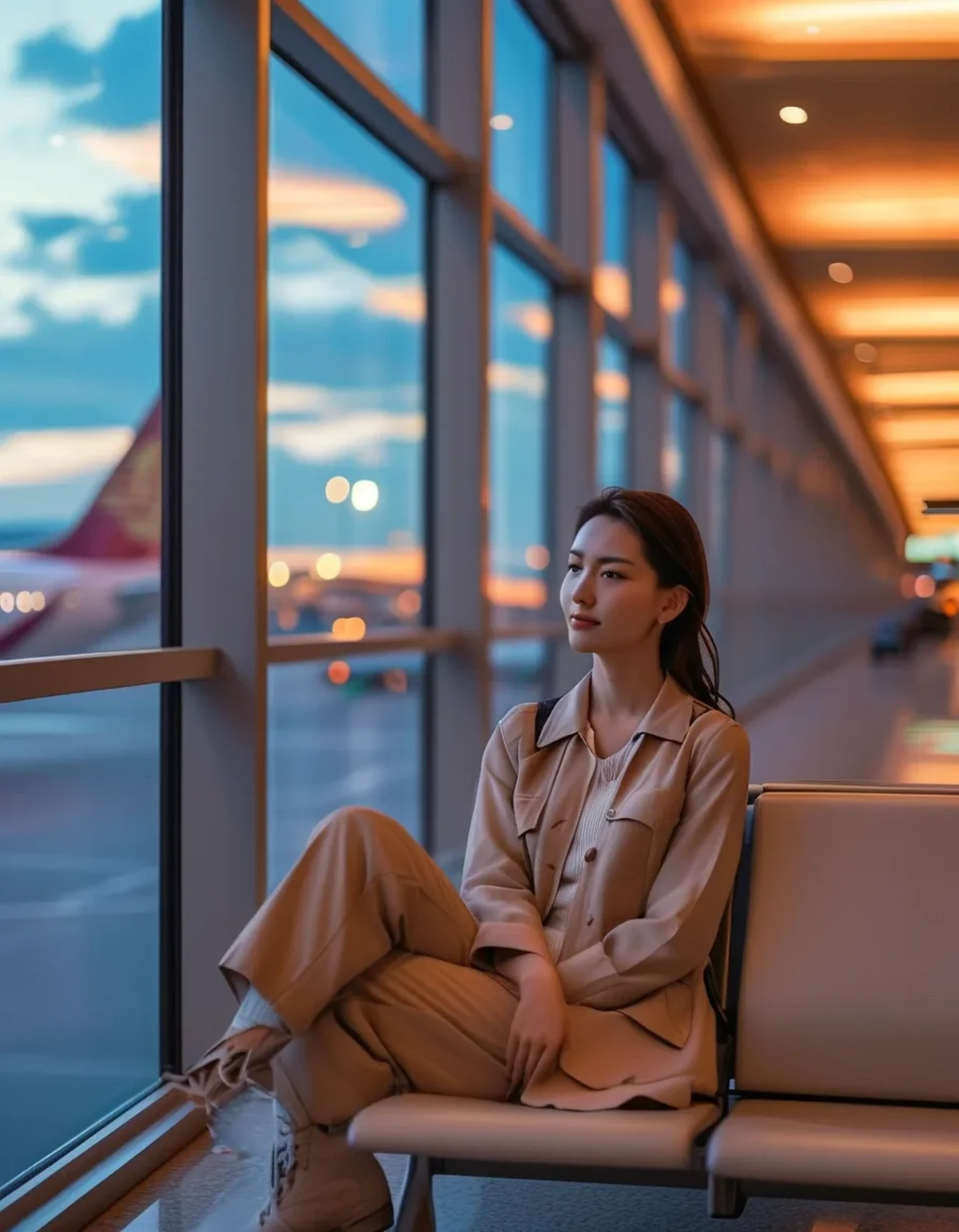
Base: something you’d be comfortable sleeping in and not embarrassed to be seen in at baggage claim. A soft long-sleeve or a fitted tank plus leggings with a wide, flat waistband. The test is whether you can sit in it for six hours without adjusting anything.
Mid: a light knit or a zip layer. This is the piece you shed at cruising altitude when the cabin is still warm and put back on when it isn’t. It should compress into a seat-back pocket without a fight.
Outer: one oversized piece — a long cardigan, a soft coat, a large scarf-wrap. This is your blanket. Airline blankets are thin, often unavailable, and you don’t want to be negotiating for one at 2am. A piece that covers your shoulders and reaches your thighs when you’re seated does more for sleep than anything else you’ll pack.
The rule underneath all three: wear the bulk, don’t carry it. Every heavy item on your body is a heavy item not in a bag you have to lift.
How do you handle the two-season problem?
This is the September-specific part. You leave a city that’s 58°F at 11pm and land somewhere that’s 84°F at 8am, or the exact reverse. One outfit has to survive both.
The fix is making the outer two layers genuinely removable in a public place. That means your base layer alone has to be a complete outfit — not a thermal you’d only wear under something. If you can walk out of arrivals in just the base and look intentional, the system works.
Color helps more than it should. A base in a mid-tone neutral reads as an outfit; a base in heather grey with visible sweat marks reads as pajamas. And one accessory that isn’t practical — a decent bag, a real pair of sunglasses — does a surprising amount of lifting when the rest of you is technically loungewear.
Pack the shed layers into the tote, not the overhead. You want them reachable when the plane starts its descent and the cabin gets cold again.
What Nobody Tells You About Red-Eye Shoes and Feet
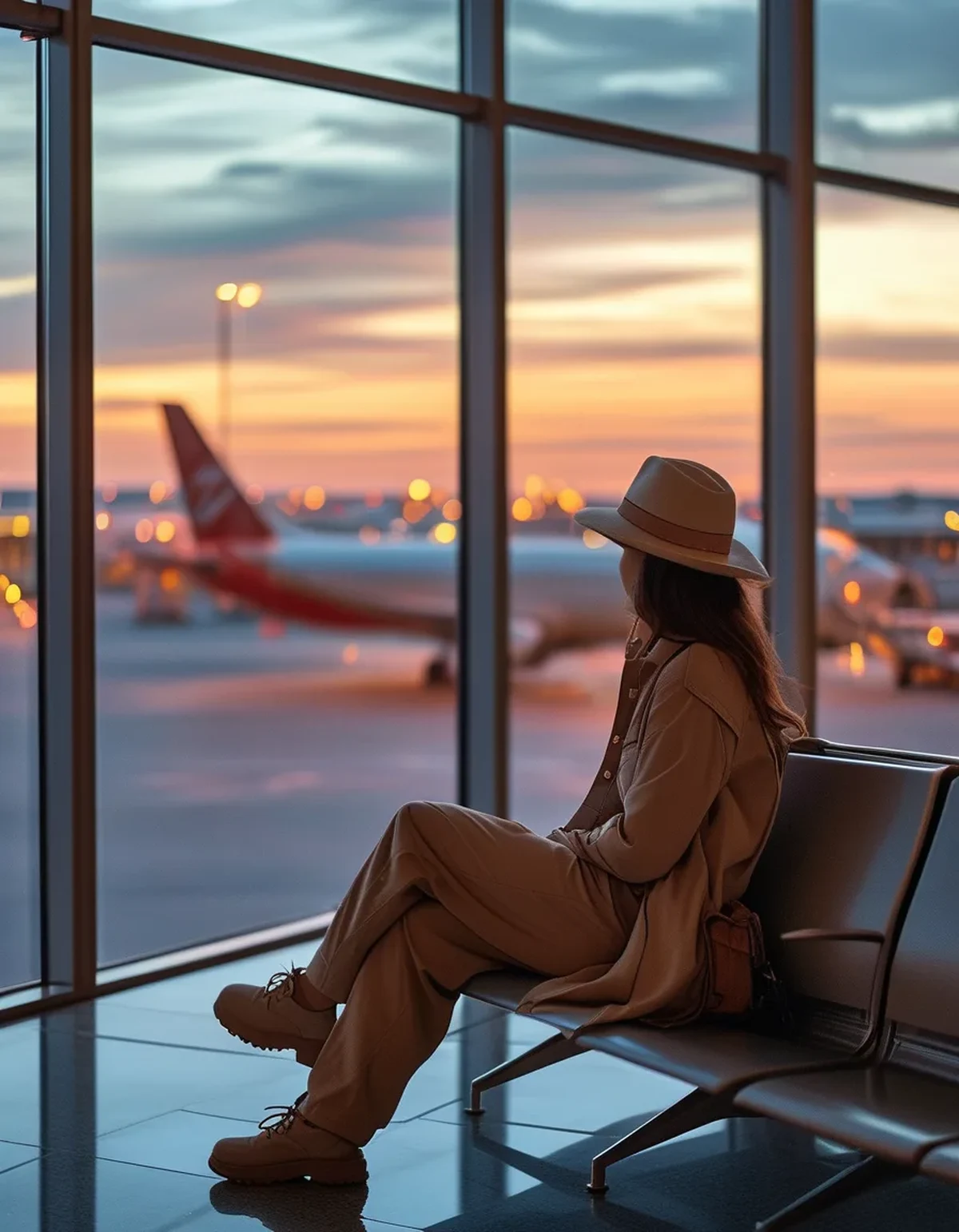
Feet swell on flights. This isn’t a rumor — sitting still at low cabin pressure means fluid pools in your lower legs, and on an overnight flight you’re immobile longer than usual. Shoes that fit at the gate can be genuinely difficult at landing.
What follows from that:
- Wear the shoes you can get back on, not the ones you can get off. Everyone slips their shoes off. The problem is at hour six.
- Slip-ons with a little structure beat both tight sneakers and floppy slides. You need to walk a terminal at the other end.
- Compression socks are the single highest-return item in this whole outfit, and almost nobody wears them because they think of them as medical. Knee-high, 15–20 mmHg, put on before boarding. The difference in how your legs feel at landing is not subtle.
- Don’t fly barefoot in the aisle. You know why.
And the thing that surprises people: swelling is worse if you’re dehydrated, not better. The instinct to drink less so you don’t have to climb over your seatmate backfires.
What should you skip entirely?
Rigid waistbands. Denim, anything with a structured button closure, anything that has a correct posture. Six hours of sitting turns a fine waistband into a pressure point.
Heavy makeup. The air is desert-dry. Whatever you apply at 10pm will be doing something else by 6am. A good balm and a moisturizer in your tote is the whole kit.
Anything that only works ironed. It will be creased. Choose fabrics that crease gracefully — knits, jersey, anything with a bit of texture — over crisp cotton that shows every hour of the flight.
Contact lenses, if you have the option. Dry cabin air plus closed eyes plus eight hours is how you land with red eyes that no amount of coffee fixes.
A single giant bag. Two smaller pieces — one overhead, one at your feet with everything you’ll actually reach for — means you never stand up in the dark trying to unzip something above a sleeping stranger.
FAQ: Red-Eye Outfit Questions, Answered
Are leggings really okay for a long flight?
Yes, and they’re one of the better options for exactly the reason people worry about — they don’t bind at a single point. Choose a thicker, opaque pair with a wide waistband over a thin compressive pair, and skip anything with mesh panels at the knee, which get cold.
Should I change clothes before landing?
Only if you’re going straight somewhere that demands it. A full change in an airplane bathroom at 6am costs more than it returns. A better version: swap the top layer, brush your teeth, and put on the one accessory you kept clean in your bag.
What about a hoodie — too casual?
A hoodie is fine as your mid layer and questionable as your outer. If the hood is the reason you want it, a soft scarf that covers your neck does the same job for sleep and looks like a decision rather than a surrender.
TL;DR:
- Build three layers: sleepable base, sheddable mid, oversized outer that works as a blanket.
- Dress for the coldest part of the flight — cabins feel colder overnight because your core temperature drops.
- Your base layer alone must be a complete outfit, because September means landing in a different season.
- Compression socks and slip-ons you can get back on matter more than anything above the waist.
- No rigid waistbands, no heavy makeup, no contacts if you can avoid them.
The goal isn’t to look good on the plane — nobody does. It’s to walk out at 7am looking like someone who chose to be there.
See It in Motion
Seen here: Super High Waist Embossed Yoga Leggings with Inner Pocket — shop it on bubblelime.com
Keep Reading
This article is for general informational and styling purposes only. Fit, sizing, and product availability may vary.