The Airport Shoe Decision: Security Lines, Swollen Feet, and the One Pair That Works

Quick Answer: The ideal airport shoe is a cushioned slip-on sneaker with a stretchy knit upper, worn with real socks: on and off hands-free for security, forgiving when your feet swell mid-flight, and supportive enough for the mile of terminal walking on each end. Skip anything brand new, anything backless, and anything with laces you have to re-tie while balancing a bin. Feet reliably swell a half size on flights over three hours - the shoe has to be chosen for landing, not for departure.
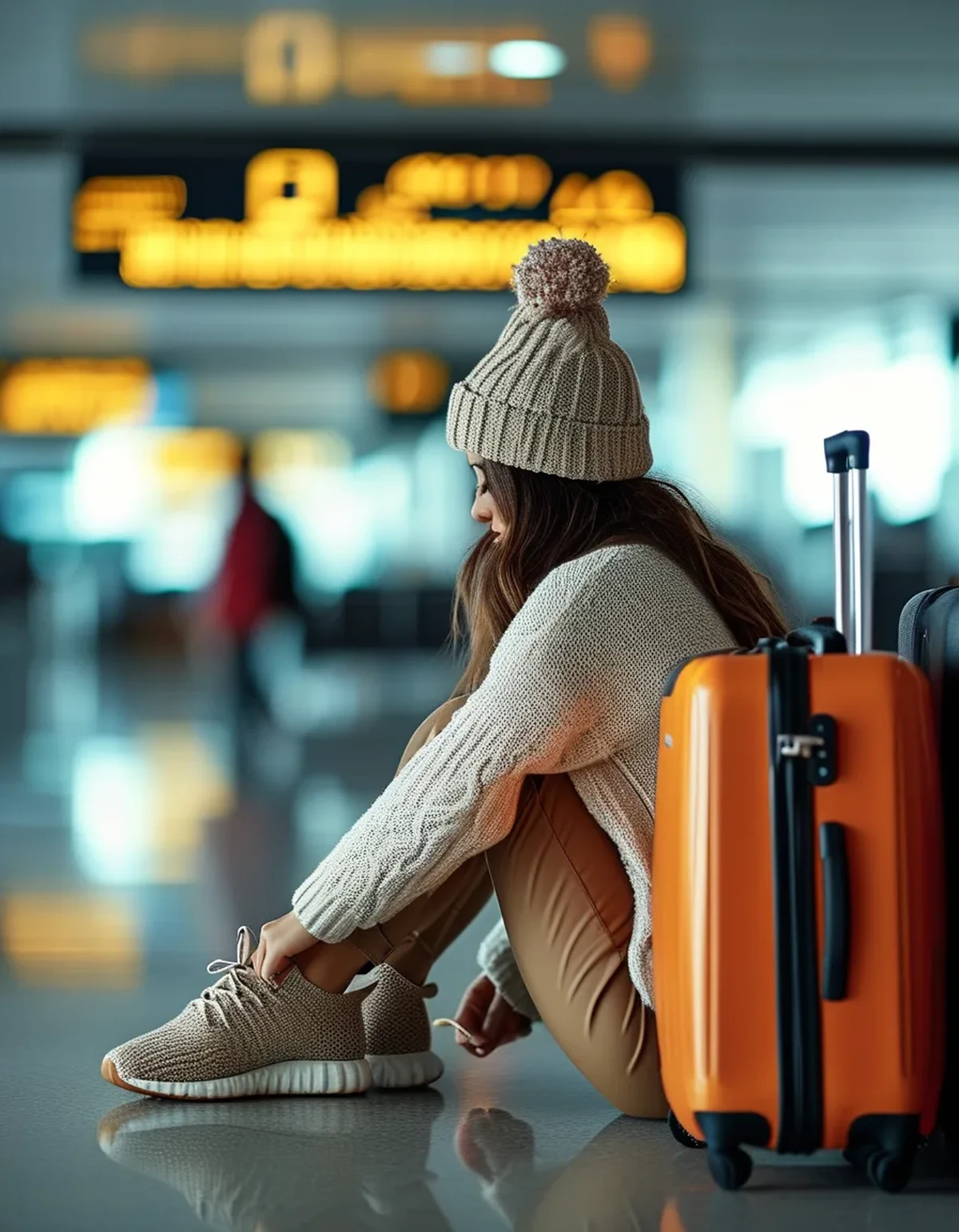
Everyone plans the airport outfit from the waist up and then spends the actual day being betrayed from the ankles down - hopping through security, hobbling to a far gate, and prying shoes off swollen feet somewhere over the middle of the country.
Why do your feet swell on a flight, and how much?
Two mechanisms stack, and neither one cares how good your shoes looked at check-in.
Sitting is the main event. Your calf muscles are the pumps that push blood and fluid back up out of your feet, and they only work when you move. Hours of sitting with knees bent and feet on the floor lets fluid pool downhill - the same reason ankles puff after a long desk day, amplified by immobility.
Cabin conditions add a percentage. Lower cabin pressure and very dry air shift how fluid distributes, and the salty snacks plus mild dehydration of travel days encourage retention on top.
The practical output: on flights past about three hours, most people land with feet somewhere between slightly and obviously bigger - commonly around a half size in volume, more on long-hauls, more in late pregnancy, more in hot weather. Swelling peaks near landing and can take hours to fully drain, which is precisely when you are standing in immigration lines and hauling bags.
This is why the shoe that felt roomy at 6am gets described as a trap by 4pm. It did not shrink. You grew - predictably, on schedule - and the whole airport shoe question is really about buying room for the landing version of your feet without flopping around in the departure version.
One health note: swelling that is one-sided, painful, hot, or accompanied by calf tenderness is not normal travel puffiness and deserves prompt medical attention. This is general information, not medical advice.
What does security actually require from your shoes?
Less than people fear, but the details decide whether you glide or hold up the line.
Assume shoes come off. Rules vary by airport, program, and scanner generation - some lanes let shoes stay on - but the only version you can plan for is the one where they go in a bin. The spec that follows: on and off in under five seconds, standing, no hands. Every lace, buckle, zip, and snug ankle cuff is a tax paid while a line watches you.
Socks are non-negotiable. Barefoot on airport flooring is its own experience, and the swelling story gives a second reason: a light compression sock or snug crew sock is doing quiet work all flight. Plan the outfit so removing shoes reveals socks you chose on purpose.
Metal is mostly a non-issue in modern scanners, but heavily buckled boots and shank-heavy footwear still buy extra screening often enough to avoid on principle.
The bin choreography matters more than the shoe’s contents. You will be holding a laptop, a liquids bag, and a boarding pass while de-shoeing. This is the argument that eliminates knee-high lace boots, strappy sandals, and anything requiring a bench and a free hand - not style, logistics.
If you have expedited screening that usually keeps shoes on, the calculus relaxes - but the swelling half of the problem remains at full strength, so the slip-on sneaker keeps winning anyway.
What is the ideal airport shoe spec?
Build the decision around four features, in priority order:
1. Slip-on entry with structure. A laceless knit sneaker, a slip-on trainer with elastic gores, or a lace-look sneaker with hidden elastic laces. Hands-free on and off, but with a real heel counter so the shoe stays attached during a gate sprint - the difference between a slip-on and a slipper.
2. A stretchy, forgiving upper. Knit and engineered mesh uppers expand with the afternoon foot instead of arguing with it. Structured leather with firm toe boxes holds its shape - which is exactly the problem when your foot changes shape mid-flight.
3. Genuine cushioning. Terminal days involve a surprising amount of hard-floor mileage - connections alone can run over a mile. A cushioned sole and decent arch support are what your knees and lower back notice at hour ten, and a removable insole leaves room for your own supportive one.
4. A roomy toe box, sized for 4pm. If you are between sizes in a travel shoe, take the larger. Pair it with socks thick enough to fill the morning gap, and the landing foot inherits the space.
The pairs to leave home: brand-new anything (airports are where blisters go to be born), backless mules and slides (they escape under seats and on escalators), flip-flops (zero support, cold cabins), tall lace-up boots (security theater), and narrow flats with no give. Comfort is not the enemy of looking put-together - a clean minimal sneaker under tailored travel layers reads far sharper than limping does.
Myth vs Fact: Airport Feet
Myth: Compression socks are for medical patients and long-haul only. Fact: Light graduated compression socks are the single most effective swelling countermeasure available to any traveler, on flights as short as three hours. Legs land fresher and shoes still fit. The medical-grade versions are a doctor conversation; the light travel versions are just good socks.
Myth: Slipping shoes off mid-flight helps your feet. Fact: It feels glorious and it is fine - but do it knowing the feet will be a size bigger when re-entry is attempted, and loosen accordingly before descent rather than wrestling at the gate. Walking to the lavatory in socks is the part to skip.
Myth: The moving walkway is rest for your feet. Fact: Standing still on it is just more standing. The best anti-swelling move in the terminal is actual walking - every stroll to a water fountain is calf-pump work that pays off on descent. Ankle circles and heel raises in the seat do the same job airborne.
Myth: Big feet after a flight means the shoes were wrong. Fact: The swelling happens in every shoe; the wrong shoe just refuses to accommodate it. Judge a travel shoe by how it treats the landing foot, not the departing one.
Myth: You need dedicated travel shoes. Fact: You need the most cushioned, most forgiving slip-on sneaker you already own, broken in and paired with deliberate socks. If a purchase happens, buy it three weeks before the trip and walk in it first - the airport is a test you do not sit cold.
How do you build the rest of the outfit around the shoes?
Feet set the foundation; the rest of the airport uniform assembles around them in layers that work with, not against, the day.
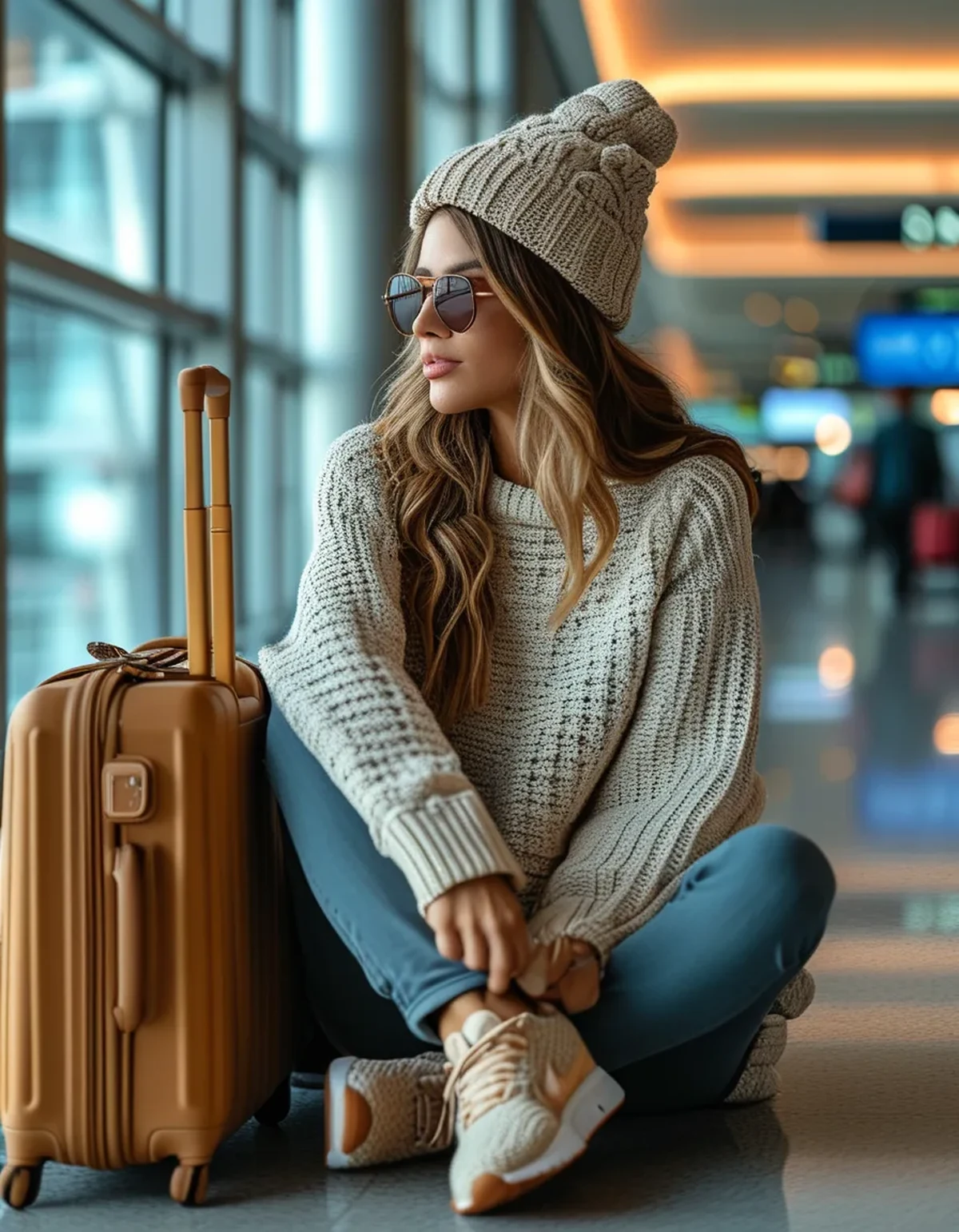
Bottoms with stretch and coverage. Full-length leggings or knit wide-leg pants pair naturally with sneakers and survive twelve hours of sitting without a waistband ultimatum. A polished pair of buttery-soft leggings in black with a longline top and structured coat is the classic formula because it genuinely works - stretch where the day bends you, structure where cameras and colleagues might see you. The sock question gets decided here too: crop-length pants plus compression socks is a look you either commit to or conceal under a longer hem.
A top warm enough for the cabin, light enough for the sprint. Cabins run cold at altitude and terminals run hot at a jog; a breathable base layer under a removable knit or zip layer covers both without a costume change.
The coat rides, not carries. Whatever jacket you bring will live on your lap or in the bin - choose one that crushes without creasing and has zip pockets to swallow the phone-passport-boarding-pass trio during security.
One bag rule for the feet’s sake. Every extra carried bag changes your gait and doubles the cost of the terminal mile. A single crossbody or backpack keeps hands free for the bin ballet and shoulders level for the walk.
The test of the whole outfit is the layover selfie at hour nine: still comfortable, still presentable, shoes still on.
FAQ: Airport Shoe Questions, Answered
Are Crocs or slides acceptable airport shoes?
They ace security and fail the rest of the day - minimal support for terminal miles, cold at altitude, and escape-prone on escalators and under seats. If maximum ease matters that much, a structured slip-on sneaker delivers it while still being a shoe.
Should I size up in travel shoes?
If you are between sizes, yes - and fill the extra room with substantial socks for the morning half of the trip. If a shoe fits perfectly snug at the store in the morning, it is a half size too small for descent.
What about wearing my bulkiest shoes to save luggage space?
A time-honored packing trick that works only if the bulky pair is also slip-on-adjacent and broken in. Wearing new hiking boots through three security lines to save a kilo is a trade most people regret by the first connection.
Do compression socks really make a difference on short flights?
On anything past about three hours, most people notice visibly less ankle puffiness and fresher legs on landing. Light graduated travel compression is inexpensive and low-commitment - the main mistake is buying them and packing them in the checked bag.
TL;DR:
- Feet swell roughly a half size on flights over three hours, peaking at landing - choose shoes for the 4pm foot
- The winning spec: cushioned slip-on sneaker, stretchy knit upper, real heel counter, roomy toe box
- Assume shoes come off at security: five-second hands-free removal, deliberate socks underneath
- Light compression socks plus terminal walking and seat ankle-pumps are the swelling countermeasures that work
- Leave home: new shoes, backless anything, tall lace-up boots, unsupportive flats
The airport is a ten-hour walking-and-waiting event dressed up as a sitting one. Pick the shoe that handles the security bin and the swollen landing with equal grace, and the whole travel day drops a difficulty level from the ground up.
See It in Motion
Seen here: High Waist Yoga Leggings with Side Pockets — shop it on bubblelime.com
Keep Reading
This article is for general informational and styling purposes only. Fit, sizing, and product availability may vary.