What to Wear When Your Layover Is 40 Minutes and You Might Have to Run

Quick Answer: Dress for the sprint, not the seat. That means shoes you can run in without adjusting, a bag that rides on your body instead of in your hand, layers that come off in one motion rather than three, and zero items that need re-tucking. The specific failure points in a rushed connection are almost always the same four: shoes that slip at the heel, a tote that swings, a waistband that needs pulling up, and a jacket you are carrying instead of wearing.
A 40-minute connection is not a delay problem, it is a wardrobe problem. Everything you wear becomes either equipment or obstacle the moment the gate agent says your onward flight is boarding in a different concourse. Here is the version of airport dressing built for that particular eight minutes.
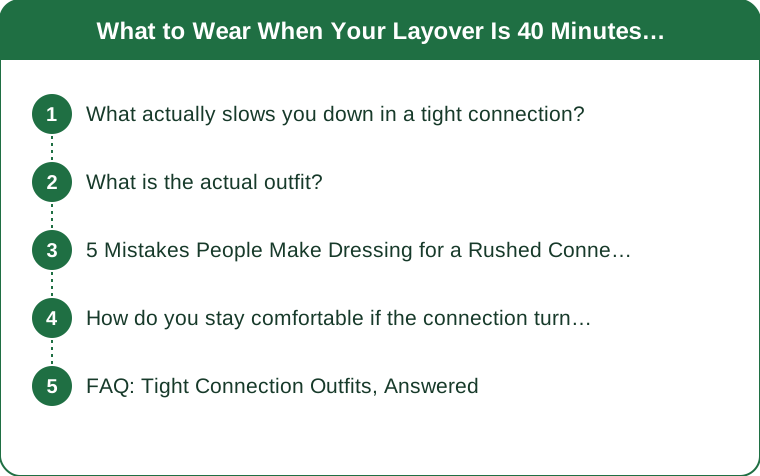
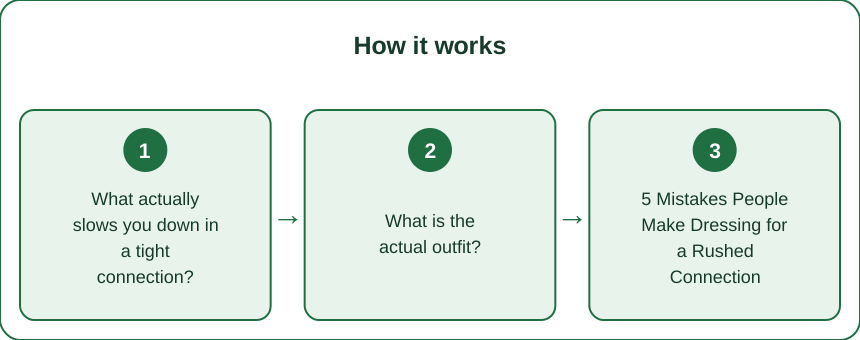
What actually slows you down in a tight connection?
It is almost never fitness. Eight minutes of fast walking is well within reach for most people. What ends up costing time is a series of small stops, and each one runs 15 to 40 seconds.
Stop one: the shoe adjustment. Backless shoes, loose slides, and unlaced sneakers all require a heel-jam step every 30 paces. You will feel it as annoyance; the clock feels it as three lost minutes.
Stop two: the bag reshuffle. A tote carried in the hand swings into your leg at speed, so you shorten your stride to compensate. A shoulder bag that slides off the shoulder gets pushed back up every 20 seconds. A backpack, cross-body, or hand-carried bag with a chest strap is the only configuration that survives running.
Stop three: the layer you are holding. A jacket over the arm occupies a hand, blocks a rail grab on the moving walkway, and slides off during the escalator scramble. Wearing it is faster than carrying it even if you are warm.
Stop four: the waistband. Anything that migrates during fast movement requires a hand and a pause. Elastic and drawcord waists solve this permanently; a mid-rise woven with a belt does not.
And the invisible one: your hands. Every connection requires holding a phone with a boarding pass. If both hands are already occupied by bags and a jacket, you stop to reorganize before you can even check the gate. Aim to arrive at the jet bridge with one hand free at all times.
What is the actual outfit?
Build from the ground up, because the ground is where the time is won.
Shoes: a laced or fully-enclosed trainer, one you have already walked three miles in. Not new, not backless, not a stiff loafer. If you want a dressier arrival, put the good shoes in the bag and change at the gate - a 90-second change beats an eight-minute hobble.
Socks: real ones, crew or ankle, not no-show. No-shows migrate under the heel during fast walking and produce a blister at exactly the wrong moment. If you are also worried about swelling, a light graduated compression sock does both jobs.
Bottoms: an elastic or drawcord waist with real stretch. Travel joggers, ponte trousers, or a straight-leg legging read as put together and move like activewear. Avoid anything that requires a belt through security, since removing and re-threading a belt is a full minute you do not have.
Base layer: a fitted top that does not need tucking. Tucked shirts untuck when you run; anything you would need to fix on arrival is the wrong choice.
Mid layer: one zip-front piece that lives on your body. A zip is a one-motion temperature control. A pullover is a two-arm, hair-wrecking, ten-second operation you will do four times between a cold cabin and a hot jet bridge.
Outer layer: only if you truly need it, and it should pack into its own pocket. Otherwise it belongs stuffed into the top of your bag before boarding, not draped over your arm.
Bag: backpack or a cross-body worn across, not on one shoulder. If you must roll a case, choose a spinner you can push in front of you at speed rather than drag behind you at an angle. Dragged bags tip on carpet transitions.

5 Mistakes People Make Dressing for a Rushed Connection
Mistake one: dressing for the destination. You will be at the destination for days and in the terminal for hours. Pack the outfit that suits arrival; wear the outfit that suits transit.
Mistake two: assuming the connection will be fine. Two thirds of the outfit choices above cost you nothing on a smooth travel day. Wearing trainers instead of loafers has no downside if the connection is generous, and enormous upside if it is not. This is a cheap hedge.
Mistake three: layering with a scarf. Scarves are excellent on the plane and terrible in a sprint - they slide, they catch, and they end up in a hand. Put it in the bag until you are seated.
Mistake four: hard trousers plus a belt plus laced boots for a security queue. Every removable item is a second on both sides of the scanner. The fastest security outfit and the fastest connection outfit are the same outfit, which is convenient.
Mistake five: the water bottle in the hand. Clip it, cage it, or pocket it. Hand-carried bottles are the single most commonly dropped object in a terminal sprint, and picking it up costs more than the hydration is worth in that moment.
The pattern behind all five: anything that requires a hand or a pause is a tax you pay repeatedly. Audit your outfit for hands and pauses, and the rest sorts itself out.
How do you stay comfortable if the connection turns out to be easy?
This is the fair objection - dressing for a sprint you might not run.
The good news is that the sprint outfit is also the comfortable-sitting outfit. Elastic waists, soft knits, trainers, and a zip layer are exactly what you want for a four-hour flight. The only real sacrifice is formality, and that is solvable with a bag-packed shoe change and a better top layer.
Add the comfort items as removable extras. Compression socks, a scarf, and a wrap live in the top of your bag. They go on once you are seated and come off before landing, which means they never become obstacles during movement.
Plan the arrival change deliberately. If you land and go straight somewhere, the change is: shoes, top layer, and one accessory. That combination changes the read of an outfit more than trousers do, and it takes 90 seconds in an airport bathroom.
One underrated upgrade: pocket placement. Zip pockets on the thigh or chest let you carry a phone and a passport without holding anything. Most travel-focused joggers have them; most fashion joggers do not. Checking for zips before you buy is the difference between a bag rummage at every checkpoint and a smooth walk to the gate.
And if you do run - warm up on the walkway. Fast walking for the first 60 seconds before breaking into a jog dramatically reduces the chance of pulling something, which is a genuinely miserable way to start a trip.
FAQ: Tight Connection Outfits, Answered
How much time do you actually need for a domestic connection?
Most airlines schedule domestic connections at 35 to 45 minutes minimum, which assumes an on-time arrival and a nearby gate. If you land late or the gate is in another concourse, you are running. Dress as if that is likely, since the outfit costs you nothing when it is not.
Are compression socks worth wearing if I might be sprinting?
Yes, and they work for both scenarios. Graduated compression helps with the swelling from a long seated flight and provides mild calf support if you end up moving fast. Choose a light 15-20 mmHg for general travel rather than a medical-grade level.
What is the fastest security outfit?
No belt, slip-resistant laced shoes you can leave on where PreCheck allows, no metal-heavy jewelry, a zip layer rather than a pullover, and a bag with an external laptop sleeve. Every item you remove is a bin, and every bin is a wait.
Should I check my bag if the connection is tight?
A checked bag will not slow your sprint, but it substantially raises the odds of arriving without it if the connection is under an hour. Carry on if you can - and if you carry on, a backpack beats a roller in a genuine run every single time.
TL;DR:
- Time in a rushed connection is lost to small stops - shoe adjustments, bag reshuffles, carried jackets, and waistband fixes - not to fitness.
- Wear laced trainers, real socks, an elastic or drawcord waist, an untucked fitted top, and one zip layer on your body rather than over your arm.
- Carry a backpack or cross-body worn across; keep one hand free at all times.
- The sprint outfit doubles as the fastest security outfit and the most comfortable seated outfit, so it costs you nothing on an easy travel day.
- Pack a shoe change and a better top layer for a 90-second arrival upgrade.
You cannot control whether the inbound flight lands late. You can control whether the next eight minutes are a brisk walk or a series of small, expensive stops - and that decision gets made in your closet, not at the gate.
See It in Motion
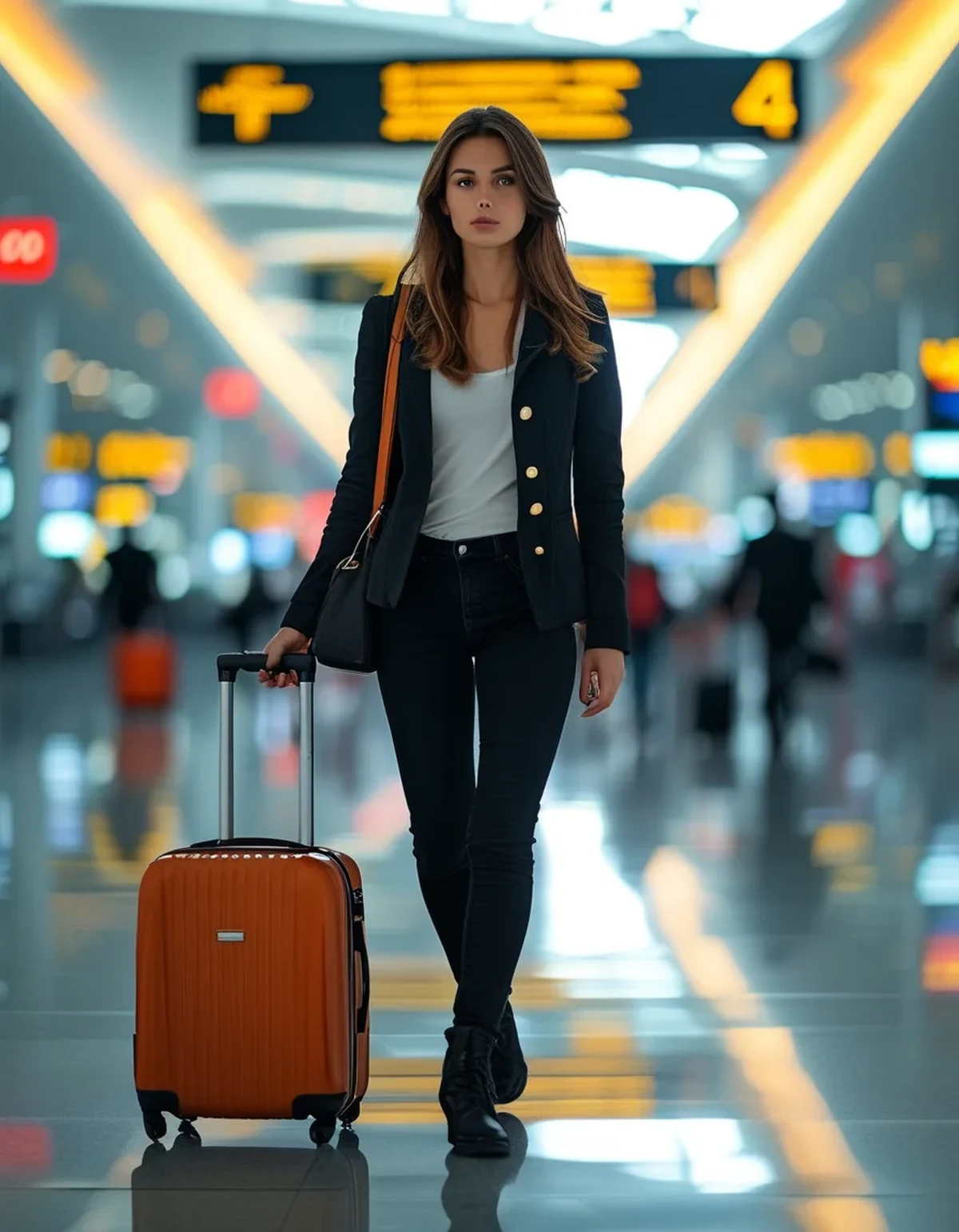
Seen here: High Waist Jogger Sweatpants with Pockets — shop it on bubblelime.com
Keep Reading
This article is for general informational and styling purposes only. Fit, sizing, and product availability may vary.