The Airport Outfit That Still Works After You Land

Quick Answer: Build the outfit around one structured bottom, one fitted base layer, and one overshirt or cardigan that reads as intentional rather than as loungewear. Change only your shoes and your top layer on arrival and the same outfit takes you from a 6am gate to dinner. The pieces that fail are the ones that only make sense horizontal - wide soft joggers, oversized hoodies, and anything you would not be seen in outside an airport.
The usual travel outfit is optimised for four hours you spend sitting down and then abandoned for the twelve you spend awake in a new place.
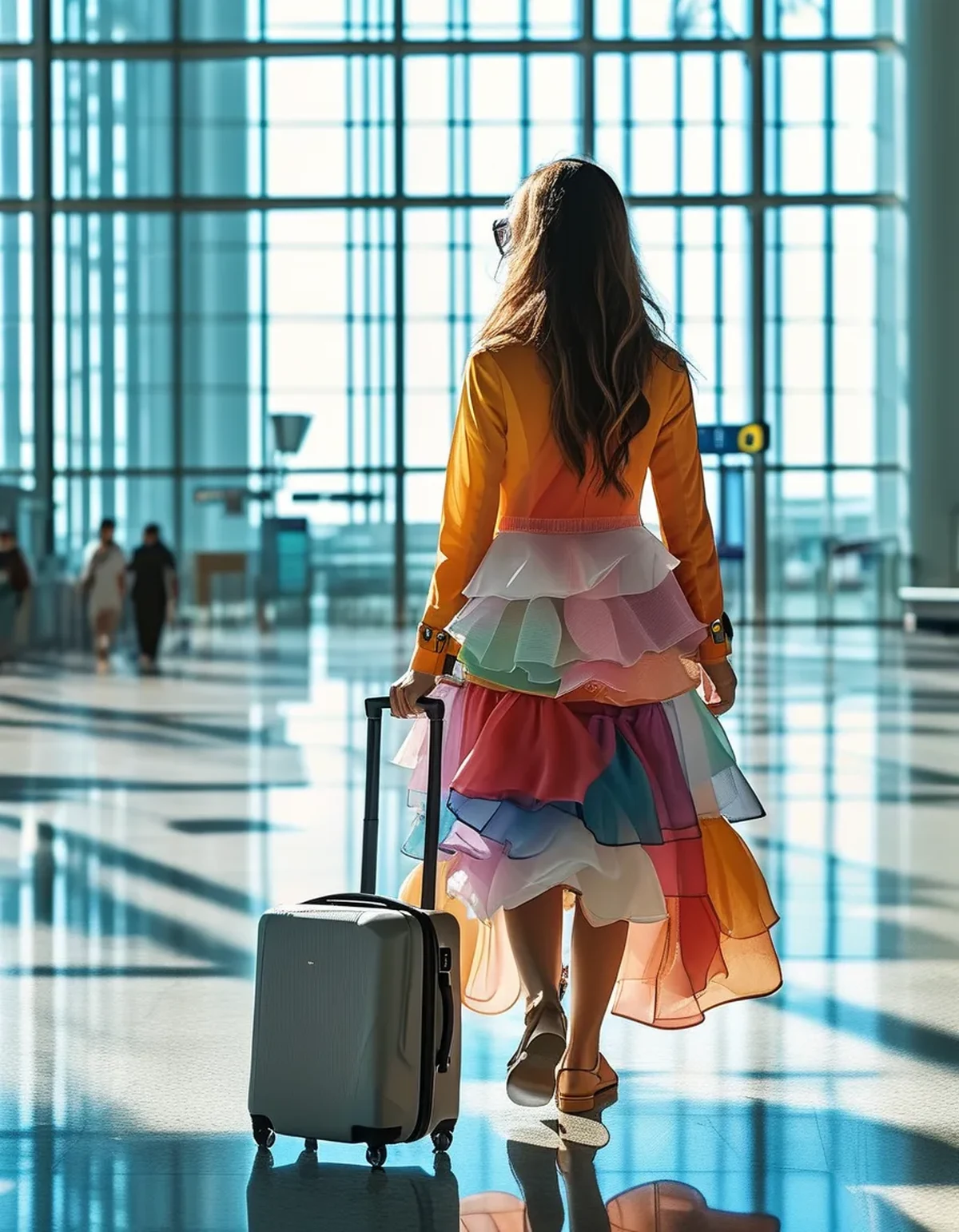
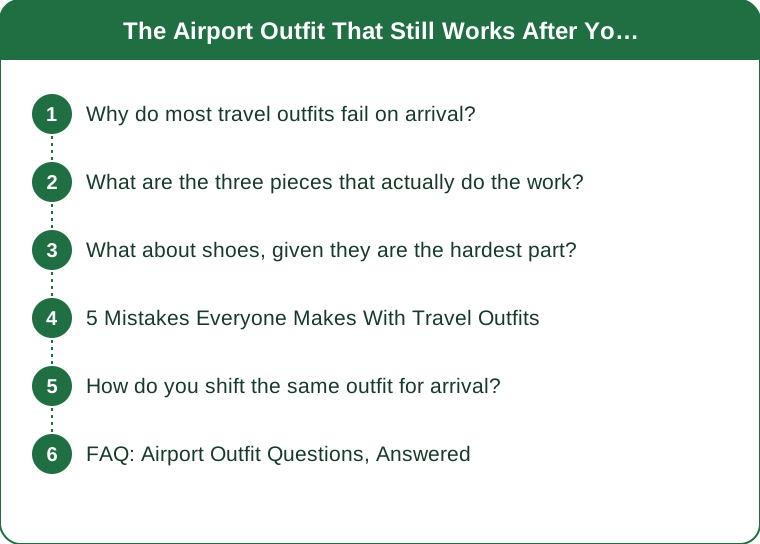
Why do most travel outfits fail on arrival?
Because they are designed against a single constraint - comfort while seated - and every other requirement gets dropped.
A flight asks for stretch, temperature range, and nothing digging at the waist. Arrival day asks for something completely different: you are walking, standing in queues, carrying a bag, probably warm, and quite possibly meeting someone or eating somewhere before your accommodation is available.
The clothes that solve only the first problem look wrong the moment you stand up. Wide soft joggers and an oversized hoodie read as pyjamas in a restaurant. Anything with a visible drawstring waist and no structure looks like it was chosen for a sofa.
The other half of the problem is creasing. Linen and rayon look excellent for the first hour and terrible after four in a seat. Fabric recovery matters more on a plane than almost anywhere else, because you are compressing the same fabric in the same places for hours.
The fix is not dressing up. It is choosing pieces that hold their shape and read as deliberate in both settings.
What are the three pieces that actually do the work?
1. A structured bottom with real stretch. A ponte or high-elastane straight-leg trouser, a slim jogger with a clean flat hem, or a well-cut legging with a wide waistband under a long top. The test: does it hold a shape when you stand, and does it not crease across the lap after four hours seated? Most technical blends pass. Most linen does not.
2. A fitted base layer. Fitted rather than tight. A ribbed long-sleeve, a good t-shirt with some structure at the shoulder, or a bodysuit if you want to guarantee it stays tucked. This is the layer that will be visible on the plane when the outer layer is your blanket, so it should be one you would leave the house in on its own.
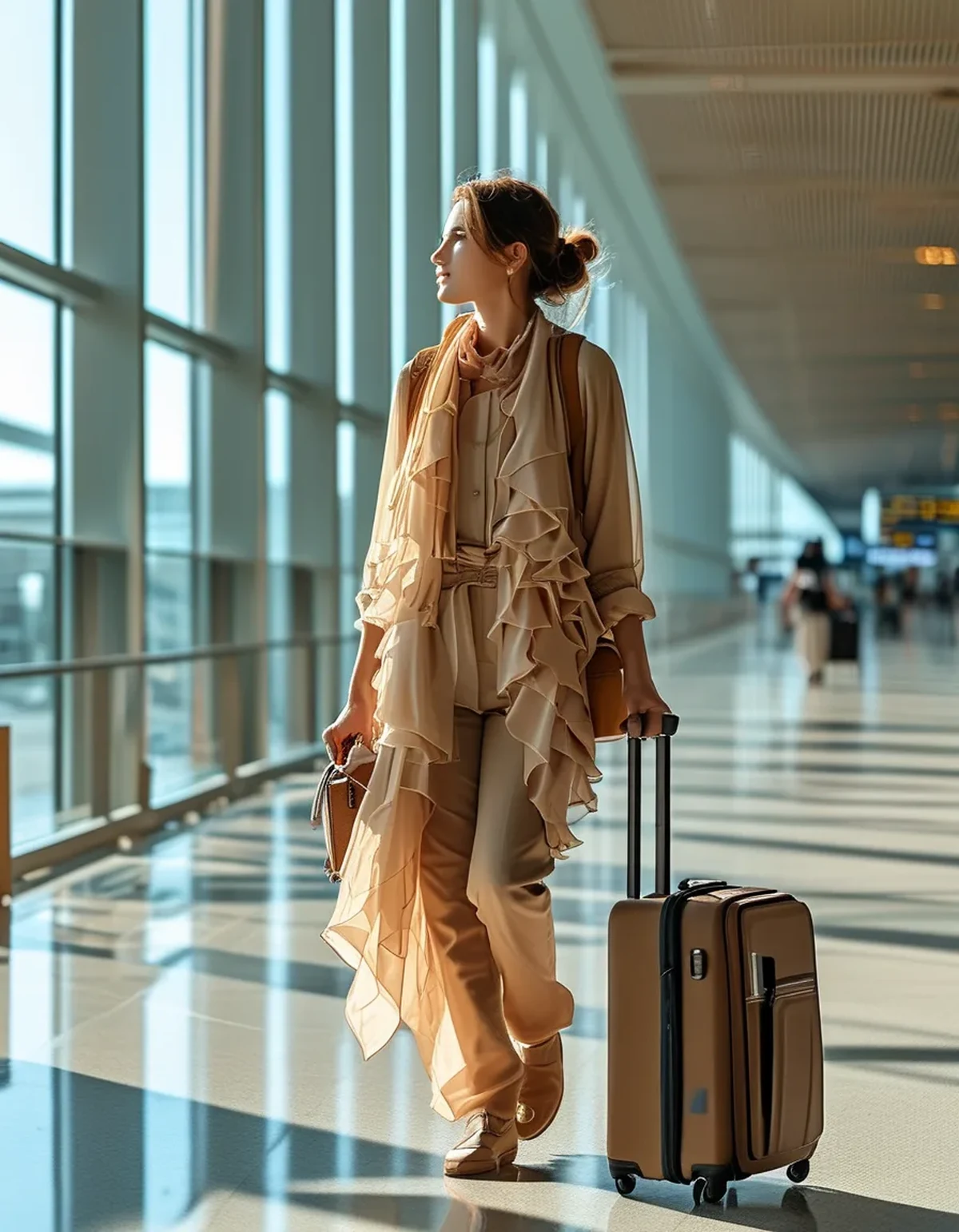
3. One overshirt, cardigan, or unstructured blazer. This piece does the heaviest lifting. It provides the temperature buffer for the cabin, it covers a creased or spilled-on base layer, and it is the single element that shifts the whole outfit from travelling to arrived.
Everything else - scarf, socks, second layer - is optional and packable. These three are the outfit.
What about shoes, given they are the hardest part?
Shoes are where travel outfits most often break, because the plane and the arrival want opposite things.
On the plane you want something you can remove easily, that accommodates feet swelling over a long flight, and that goes back on without a fight. On arrival you often want something you can walk several kilometres in.
The best single answer is a clean, low-profile trainer with laces you can genuinely loosen. Slip-ons feel easier at security and then have no adjustment when your feet swell. Boots are warm and slow at security. Sandals leave your feet cold in the cabin and unsupported when walking.
Two practical details:
- Wear the bulkiest shoes rather than packing them. This is the oldest packing advice for a reason - shoes are the single worst use of case volume.
- Pack one flat, foldable second option in the outer pocket of your carry-on. Flat sandals in summer, a slim flat in cooler weather. This is your change on arrival, and it takes almost no space.
Socks matter more than people expect. Cabin floors are cold, security queues are barefoot, and a thin merino sock handles both far better than cotton.
5 Mistakes Everyone Makes With Travel Outfits
1. Dressing for the departure temperature. You are leaving a warm late-summer morning and arriving somewhere at 11pm, possibly in a different climate entirely. Dress for the coldest point of the journey, which is almost always the cabin, and layer down.
2. Wearing anything with a rigid waistband. Not just uncomfortable - genuinely uncomfortable in a way that ruins a long flight, because your midsection changes measurably over hours of sitting and cabin pressure.
3. Packing the layer you will need in the overhead locker. The bag goes above your head and stays there through the descent when the cabin gets coldest. Keep the outer layer at your seat, always.
4. Choosing white or very pale colours. The realistic outcome of an eight-hour journey involving coffee, aeroplane food, and a taxi is at least one mark. Mid-tones and prints hide a journey; pale solids display it. This is the mistake that shows up in every arrival photo.
5. Wearing brand new shoes. Airport days routinely involve far more walking than an ordinary day, often with a bag. A blister at hour two of a fourteen-hour day is a genuinely bad start to a trip.
How do you shift the same outfit for arrival?
Three swaps, all doable in an airport bathroom in under five minutes.
Swap the shoes. The single biggest visual change for the least space. Trainers off, flats or sandals on, or the reverse if you are landing somewhere cooler.
Change or add the top layer. If the overshirt has been your blanket for six hours, swap it for the clean one rolled in your bag. If you have been in just the base layer, put the overshirt on. Either direction reads as fresh.
Reset the details. Hair up if it was down, or down if it was up. A different pair of earrings weighing nothing. Sleeves pushed up. These sound trivial and they carry a surprising amount of the effect.
What to keep the same: the bottoms. Changing trousers in an airport bathroom is a hassle and unnecessary if you chose a bottom with good recovery in the first place.
Budget a small pouch with a face wipe, a travel deodorant, a hair tie, and a spare pair of socks. The pouch does more for how you feel on arrival than any single garment, and it fits in the outer pocket.
FAQ: Airport Outfit Questions, Answered
Are leggings acceptable as travel wear?
Yes, when they are a structured pair worn with a longer top or an overshirt, and when they hold shape rather than bagging at the knee. Thin, worn-out leggings under a short top are what people are actually objecting to when they say leggings do not travel well.
What is the best fabric for a long-haul flight?
A technical blend with elastane, or a merino knit. Both resist creasing, manage temperature, and handle a long wear without holding odour. Linen and viscose look wonderful for an hour and crease permanently.
Should I wear a bra with underwire on a long flight?
Entirely personal, but many people prefer a soft, wireless, or low-compression bra for anything over about four hours, and pack the structured one. Comfort while seated for a long stretch is a legitimate criterion.
How do I handle a big temperature difference between departure and arrival?
Wear the mid-weight version of everything and pack the extremes. A base layer plus overshirt covers a wide band; a packable lightweight jacket handles the cold end and rolls to nothing.
TL;DR:
- Build around three pieces: structured bottom, fitted base layer, one overshirt or cardigan
- Choose fabrics with recovery - technical blends and merino over linen and viscose
- Wear the bulkiest shoes, pack one flat second pair for arrival
- Dress for the coldest point of the journey and keep the outer layer at your seat
- Swap shoes, swap the top layer, reset the details - five minutes and the outfit reads as arrived
The good news is that this is a smaller wardrobe than the usual approach, not a larger one. Three well-chosen pieces that work standing up will beat a specialised flight outfit plus a change of clothes, and they take up less of your bag while doing it.
See It in Motion
Seen here: High Waist 8” Yoga Shorts — shop similar styles on bubblelime.com
Keep Reading
This article is for general informational and styling purposes only. Fit, sizing, and product availability may vary.